Introduction
When voice goes down, business stops. Customers cannot reach the contact center, branches cannot reach suppliers, and in the worst case an employee cannot reach emergency services.
Outages are also getting more expensive. In the Uptime Institute's Global Data Center Survey 2026, 71% of operators who had an outage said their most damaging incident cost at least $100,000, up from 57% the year before, and 19% said it cost more than $1 million. Uptime's 2026 Annual Outage Analysis adds a warning that matters for voice in particular: outages linked to fiber and connectivity failures are rising and tend to last longer. Cloud calling only works when the path to the cloud works.
The good news is that high-availability (HA) voice is a well-understood engineering problem. This guide walks through what "five nines" really means in 2026 and how to design each layer so it holds up.
What "Five Nines" Really Means
Availability targets translate into a surprisingly small amount of permitted downtime:
- 99.9% (three nines): about 8.8 hours of downtime per year
- 99.99% (four nines): about 53 minutes per year
- 99.999% (five nines): about 5 minutes per year
Provider SLAs are only part of the story
Microsoft offers a financially backed 99.999% uptime SLA for Teams Phone, Teams Calling Plans and Audio Conferencing. Cisco backs Webex Calling with a 99.999% SLA, and Zoom offers up to 99.999% for Zoom Phone. As Zoom itself points out, these SLAs apply only to the provider's own infrastructure. Your users experience the whole chain: their device, the LAN, the WAN or internet link, the SBC, the carrier and the cloud.
Availability multiplies
When components are chained in series, their availability multiplies, so the weakest link dominates:
- A 99.999% cloud service reached over a single 99.9% internet link delivers roughly 99.9% to users, the same as the link.
- Add a second, independent link and that layer rises to about 99.9999% (1 − 0.001²), lifting the end-to-end figure back to roughly 99.999%.
That is the core principle of HA design: remove single points of failure, and make sure the redundant paths really are independent.
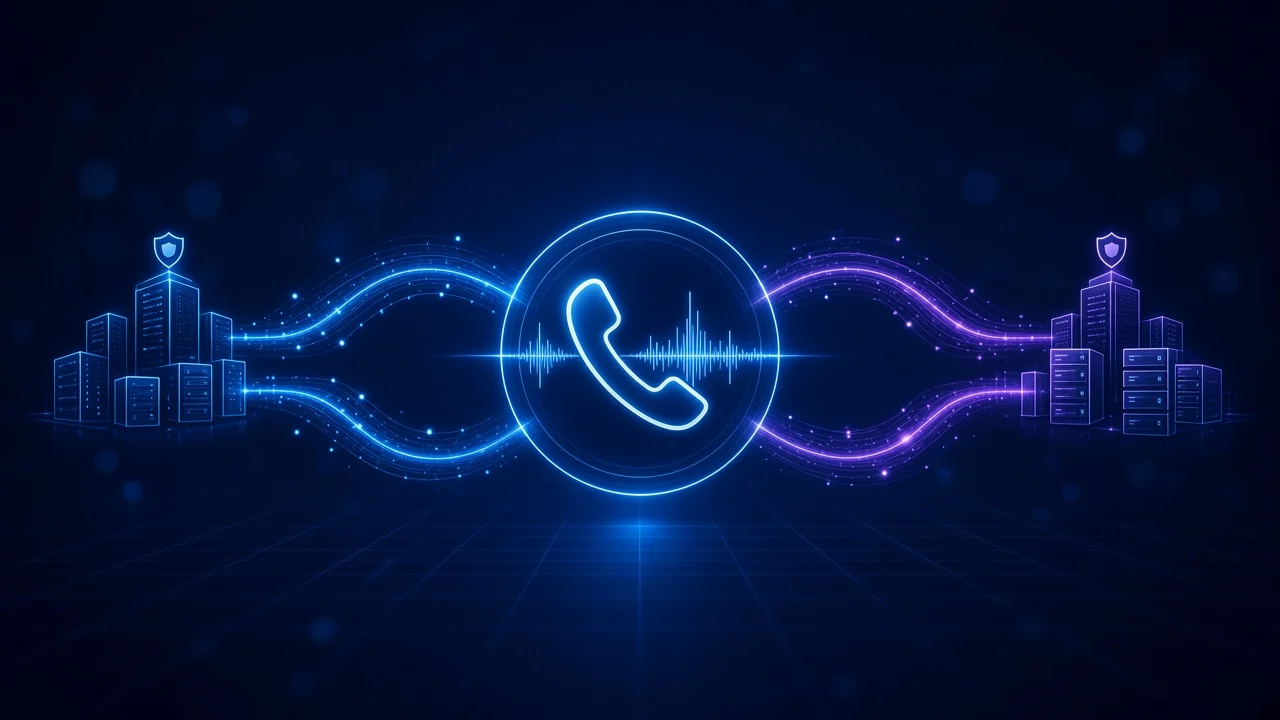
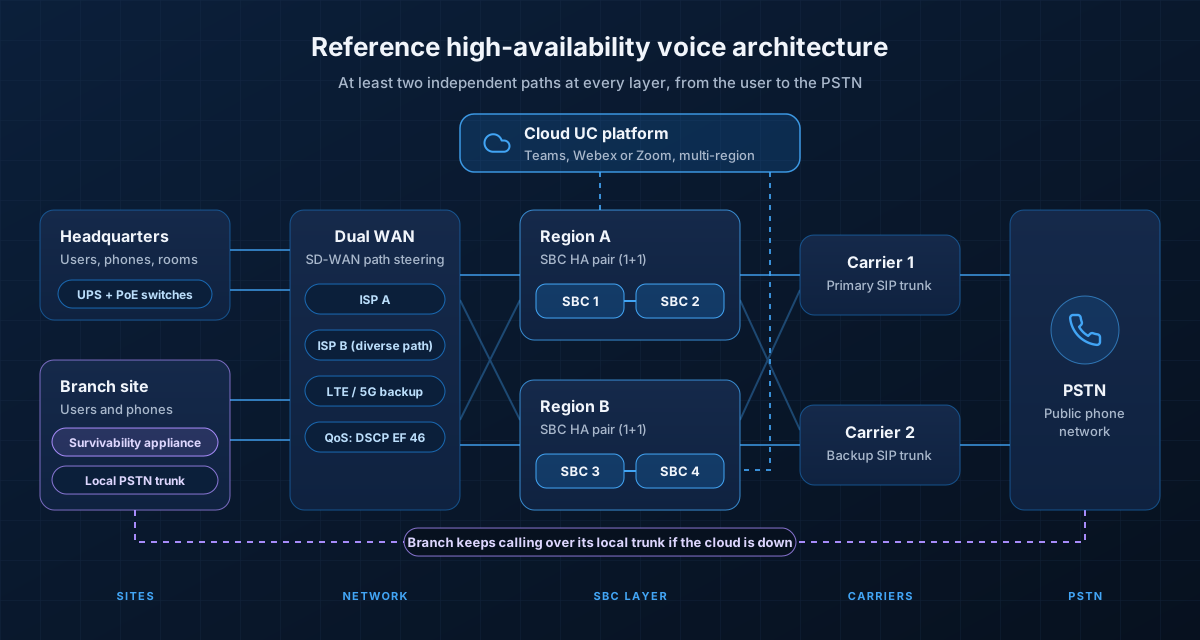 A reference HA voice architecture. Every layer has at least two independent paths, and branch sites can keep calling even if the cloud is unreachable.
Designing Each Layer for Availability
1. Call control
For cloud platforms such as Teams Phone, Webex Calling and Zoom Phone, call control is already spread across multiple regions by the provider. Your job is to make sure users can always reach it. For on-premises or dedicated platforms such as Cisco Unified Communications Manager, run clustered call control across two data centers, with phones registering to a primary server and failing over to a secondary one in the other site.
2. Session border controllers
The SBC sits between your voice platform and the carriers, so it must never be a single point of failure.
- Local HA: deploy SBCs as 1+1 pairs that share state, so a hardware or software failure moves calls to the standby within seconds.
- Geographic redundancy: place a second pair in another data center or cloud region. A local pair in the same rack does not help if the whole site loses power or connectivity.
- Capacity: size each node so it runs at no more than 50% of its rated capacity in normal operation. Otherwise the survivor cannot carry the load when its partner fails.
- Failback: prefer manual failback, so a node that keeps failing intermittently does not bounce traffic back and forth.
For Microsoft Teams Direct Routing, a few platform details make or break failover:
- Configure all three Microsoft SIP proxies in priority order:
sip.pstnhub.microsoft.com,sip2.pstnhub.microsoft.comandsip3.pstnhub.microsoft.com. Allow signaling from all Teams IP ranges, not just the addresses DNS returns. - Keep SIP OPTIONS enabled. Microsoft treats an SBC as healthy only if it has sent OPTIONS within the last three minutes.
- Know the failover defaults on
Set-CsOnlinePSTNGateway: calls fail over to the next SBC on SIP responses 408, 503 and 504, or if the gateway does not answer within 10 seconds. - Put two or more SBCs in each voice route, and check the order of PSTN usages in your voice routing policies. A catch-all usage placed first means later backup routes are never evaluated.
3. PSTN carrier diversity
Even a perfect SBC design fails if your only carrier has an outage.
- Use two carriers with priority-based routing in the SBC, so outbound calls switch automatically.
- Agree on inbound number failover with your carriers in advance, such as forwarding main numbers to a secondary trunk or a mobile number if your SBCs are unreachable.
- Combine connectivity models where it makes sense. Teams supports Calling Plans, Operator Connect and Direct Routing in the same tenant, so critical sites can have a different path from the rest of the business.
4. Network and WAN
Most voice outages that users notice are really network outages.
- Use two internet or WAN circuits from different providers, and confirm they take physically diverse routes into the building. Two circuits in the same duct fail together.
- Use SD-WAN to steer voice onto the healthiest path in real time, with LTE or 5G as a last-resort backup.
- Mark voice traffic with DSCP EF (46) and honor it end to end, including Wi-Fi.
- Keep one-way delay within 150 ms, the ITU-T G.114 guideline for good conversational quality, and watch jitter and packet loss closely.
5. Branch survivability
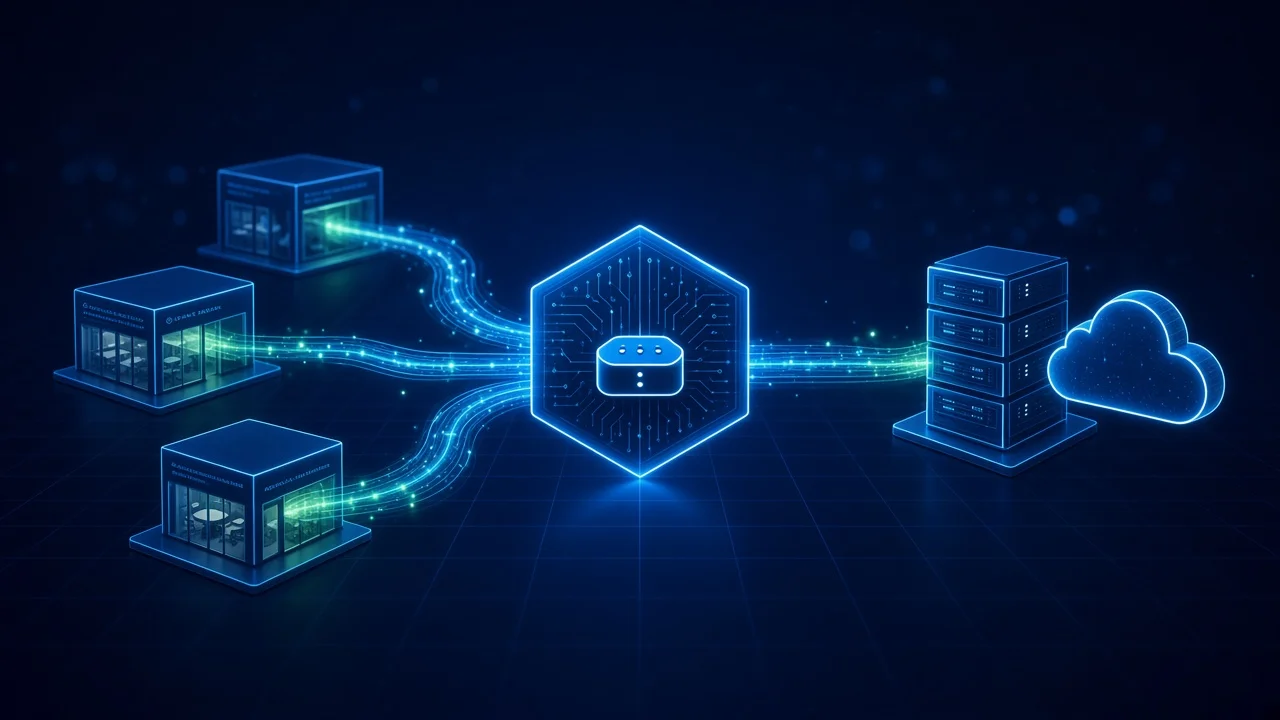
Sometimes a branch loses its connection to the cloud entirely. Survivability features keep basic calling working locally:
- Microsoft Teams Survivable Branch Appliance (SBA): runs on a supported SBC with Direct Routing and media bypass. During an internet outage, Teams desktop clients and Teams Phones switch to the SBA and can still make and receive PSTN calls, hold, transfer and forward. Important limits: VMs and web clients are not supported; emergency calls work but location information is not shared; and if the tenant uses Continuous Access Evaluation (CAE) tokens, SBA mode works for only about 30 minutes.
- Webex Calling Site Survivability: a Cisco IOS XE router acts as a survivability gateway for internal calls and local PSTN calling.
- Zoom Phone Local Survivability (ZPLS), running on Zoom Node, keeps internal calling between users at the same site working.
The common requirement is a local PSTN connection at the branch. A cloud-only carrier cannot deliver calls to a site that has lost its internet link.
6. Endpoints and power
- Put PoE switches, routers, SBCs and survivability appliances on UPS, sized for your target outage duration, and on generator power where available.
- Register desk phones to a secondary call-control node or region.
- Make the mobile app an official fallback for key staff, with clear instructions on when to use it.
7. Contact center and critical numbers
Main numbers, call queues and auto attendants are often the first thing customers notice. Give them redundant routing, an overflow destination such as a second site or an answering service, and a pre-recorded outage message that can be switched on quickly.
Emergency Calling Is Part of HA
In the United States, Kari's Law requires multi-line telephone systems, including cloud and IP-based systems, to allow direct dialing of 911 without a prefix and to notify a central point such as security when a 911 call is made. RAY BAUM'S Act requires a dispatchable location, meaning the street address plus details such as floor or room, to be sent with 911 calls. Many other countries have similar rules.
High availability has to include emergency calling:
- Test 911 or your local emergency number on every failover path, including survivability mode.
- Remember the Teams SBA limitation: emergency calls still connect, but location is not sent. Emergency dial strings must also match a pattern in your regular voice routing policy, or they will fail through the SBA.
- Keep a local emergency route, such as an analog line or local trunk, at sites where regulations or risk require it.
Failure Domains and Recovery
A useful design exercise is to list every failure domain and confirm what takes over, and how quickly.
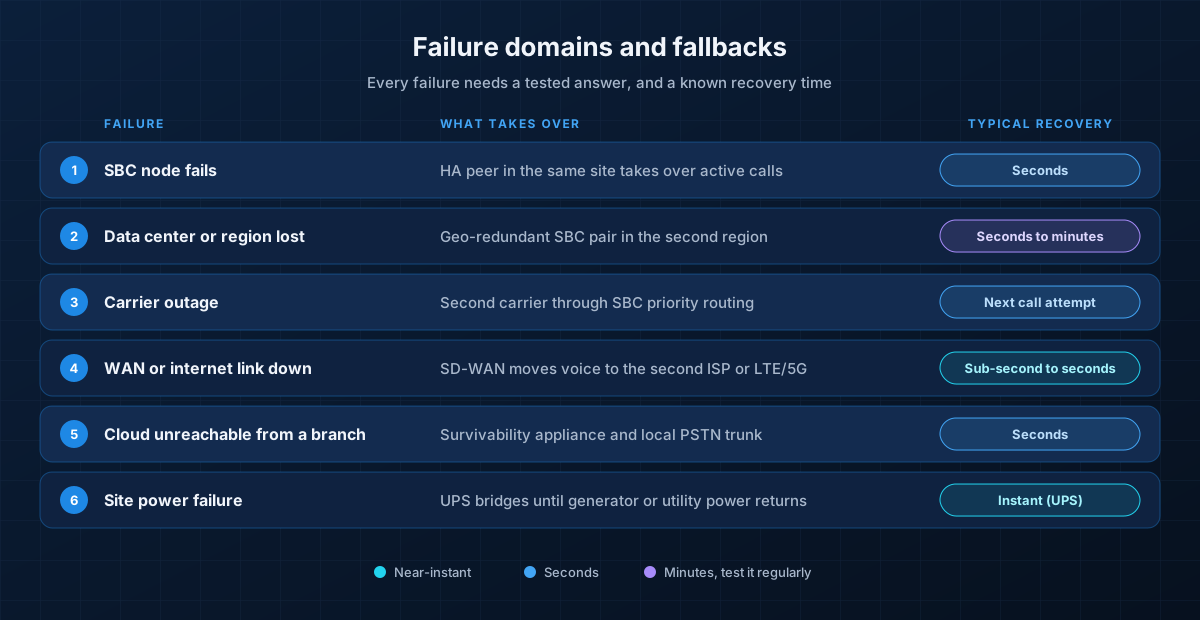 Map every failure domain to a tested fallback. If any row has no answer, that is your next project.
Testing and Operations
HA that has never been tested has not been proven.
- Run forced failover drills every quarter: fail an SBC node, a carrier trunk and a WAN link during a planned window.
- Run at least one full-site disaster recovery exercise per year, including emergency calling and contact center routing.
- Use synthetic test calls every few minutes from each site and region to catch failures before users do.
- Alert on voice quality metrics, including MOS, jitter, packet loss and call setup failures, not just device status. AIOps tools can correlate these with network events automatically.
- Keep runbooks for every failover and failback, and update them after every drill and incident.
- Treat SBC firmware, routing policy and certificate changes as high-risk changes with peer review and rollback plans.
HA Voice Design Checklist
- Availability target agreed and calculated end to end, not just the provider SLA
- Call control redundant across regions or data centers
- SBCs deployed as HA pairs in two locations, each node at 50% capacity or less
- Teams Direct Routing configured with all three SIP proxies, SIP OPTIONS on and backup routes tested
- Two carriers with outbound routing failover and an inbound number failover plan
- Two physically diverse WAN or internet circuits, SD-WAN and QoS in place
- Branch survivability deployed at critical sites, with a local PSTN connection
- UPS and generator coverage for all voice infrastructure
- Emergency calling tested on every failover path, with dispatchable location configured
- Quarterly failover drills, annual DR exercise and synthetic call monitoring
Conclusion
Five nines for voice is not something you buy from a provider. It is something you design, end to end, across call control, SBCs, carriers, networks, branches and power, and then prove through regular testing. The good news is that every building block is mature and well documented in 2026.
XeroStop designs and operates high-availability voice platforms for enterprises across Microsoft Teams, Webex, Zoom and on-premises systems. See our HA VoIP architecture solution, read our guide to AIOps, or talk to our team about your voice resilience.
Sources
- Uptime Institute: Annual Outage Analysis 2026
- Uptime Institute: Global Data Center Survey 2026
- Microsoft: Teams Phone (99.999% SLA and Survivable Branch Appliance)
- Microsoft Learn: Plan Direct Routing
- Microsoft Learn: Survivable Branch Appliance for Direct Routing
- Microsoft Learn: Set-CsOnlinePSTNGateway
- Cisco Webex: Enterprise-grade reliability with Webex Calling
- Zoom: Zoom Phone 99.999% SLA and Local Survivability
- TelcoBridges: High availability for VoIP, failover strategies
- FCC: Kari's Law and RAY BAUM'S Act requirements for multi-line telephone systems
- ITU-T Recommendation G.114: One-way transmission time