Introduction
IT operations has reached a turning point. Systems are more distributed than ever, telemetry volumes keep growing, and the cost of getting it wrong is high. New Relic's 2026 Observability Forecast puts the average cost of a high-impact outage at $1.85 million per hour, more than $30,000 a minute.
The people responsible for keeping those systems running are overwhelmed by noise. In NeuBird's 2026 State of Production Reliability report, 57% of organizations said more than 70% of the alerts they receive are not actionable, and 44% had an outage or incident in the past year that was linked to an ignored or suppressed alert.
This is the problem AIOps was created to solve. What has changed in 2026 is how much of the work AI can now do: it no longer just highlights anomalies but investigates them, explains them and, within limits, fixes them.
What AIOps Means in 2026
AIOps, short for artificial intelligence for IT operations, has gone through three distinct phases:
- Correlation (around 2016 to 2022): machine learning grouped related alerts, reduced noise and flagged anomalies. Humans still did all of the investigation.
- Assistants (2023 to 2024): generative AI added natural-language search, incident summaries and suggested next steps.
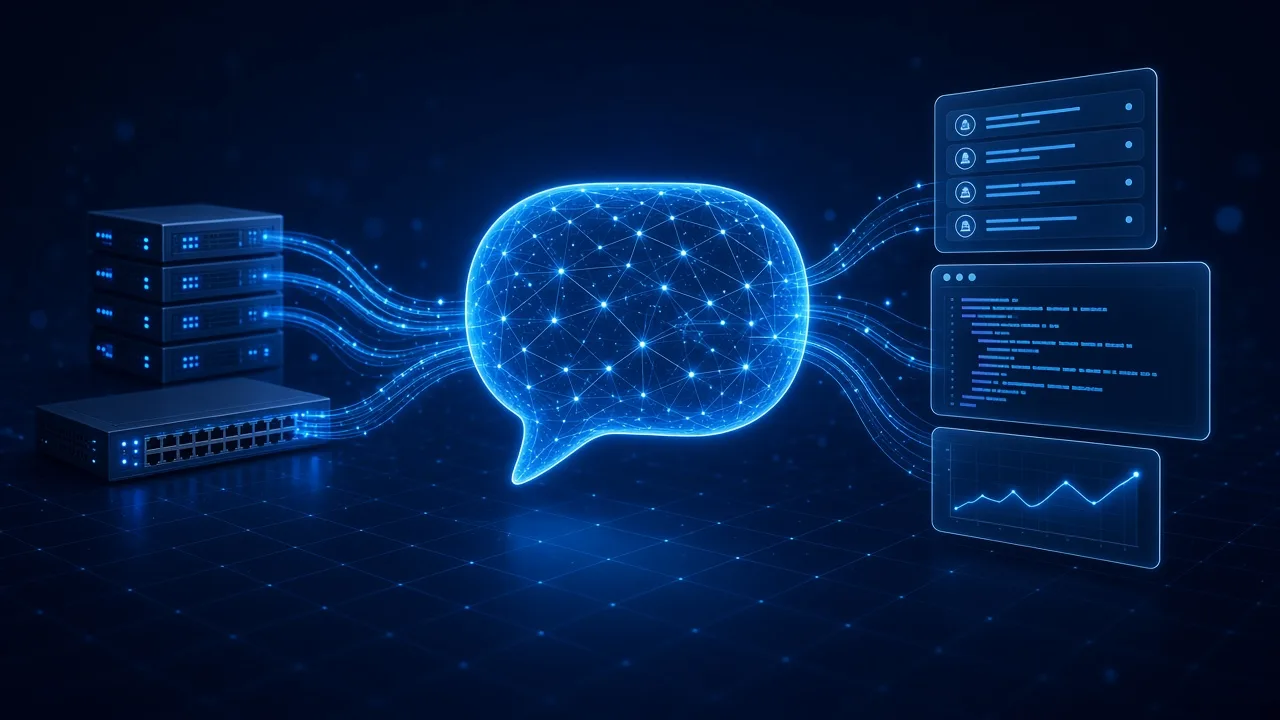
- Agents (2025 onwards): AI agents now run multi-step investigations on their own. They query logs, metrics and traces, check recent changes, form a hypothesis, and propose or carry out a fix, with humans approving the actions that matter.
The result is a continuous loop rather than a one-way pipeline of alerts.
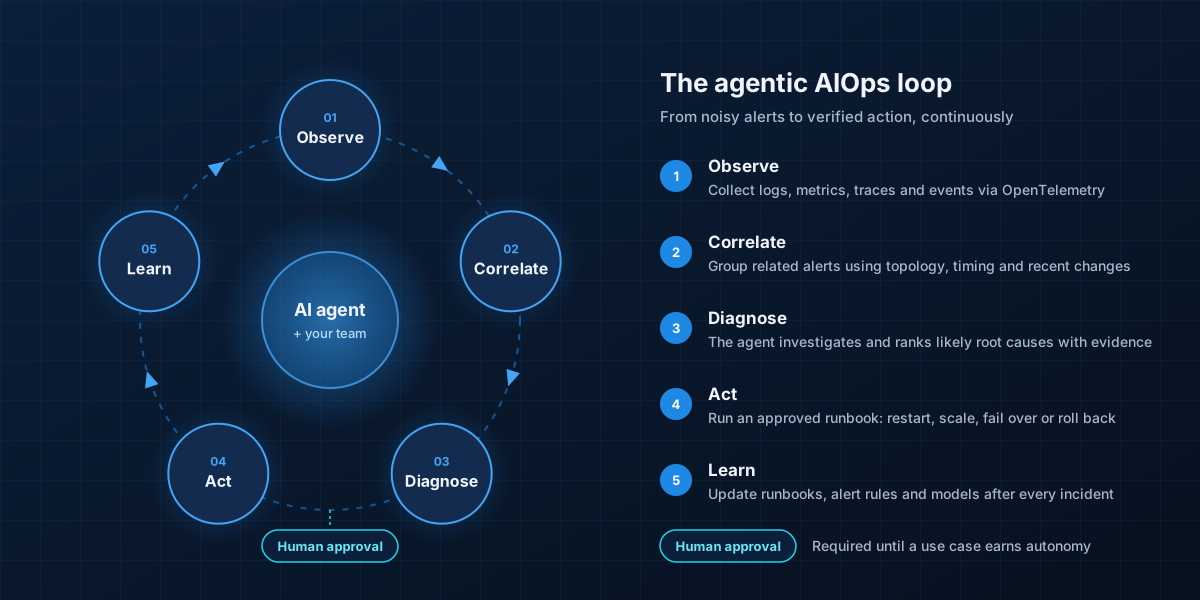 The agentic AIOps loop. Every action passes a human approval gate until the use case has earned enough trust to run on its own.
The State of AIOps in 2026
The 2026 research paints a consistent picture: real gains, broad adoption, and a lot of caution about autonomy.
- Faster detection and recovery. Splunk's State of Observability 2026 found that 86% of teams using agentic AI improved their mean time to detect (MTTD), and 72% improved their mean time to resolve (MTTR). 42% called the MTTR gain significant.
- Not instant, though. The same report found that 14% saw MTTR get worse at first. Splunk calls this the "verification tax": the time spent checking an agent's work while it is being onboarded, much like a new team member.
- Agents are already doing real work. IBM reports that 53% of organizations say agents already handle at least a quarter of their IT operations tasks, within human-monitored guardrails.
- Automation still has a long way to go. Riverbed's 2026 global survey found that only 19% of IT operations are automated today, and 77% of organizations are hesitant to let AI make operational decisions without human approval.
- Analysts expect fast change, but not full autonomy. Gartner predicts that AI agents will be built into 60% of IT operations tools by 2028, and that the share of agentic workflows with a human in the loop will fall from 95% in 2025 to 40% by 2028. It also expects only 15% of agents to be fully autonomous within the next seven years.
- Generative AI is now standard in observability. Dimensional Research's 2026 study for Elastic found that 94% of teams use generative AI for observability, and OpenTelemetry in production grew from 3% to 10% in a year.
- The agents need watching too. New Relic found that 24.6% of organizations run AI agents without monitoring them.
Seven High-Value AIOps Use Cases
1. Noise reduction and event correlation
This is still the fastest win. AIOps groups thousands of related alerts into a handful of incidents using topology, timing and past patterns, suppresses duplicates and flapping checks, and routes what remains to the right team. Splunk found that 58% of teams now use AI agents frequently to keep improving alert configuration, with humans still setting the thresholds.
2. Anomaly detection and predictive maintenance
Instead of static thresholds, models learn the normal behavior of each service, including daily and weekly cycles, and flag deviations early. Typical predictions include disk and capacity exhaustion, memory leaks, certificate expiry, failing hardware and license limits, all raised days before they become incidents.
3. AI-assisted root cause analysis
This is the "AI SRE": an agent that picks up an incident, pulls the relevant logs, metrics, traces and recent deployments, and presents a ranked list of likely causes with supporting evidence. 62% of teams in Splunk's survey use AI agents frequently to determine root causes, making it the most common agentic use case.
4. Automated remediation with guardrails
For well-understood problems, agents can run approved runbooks: restart a service, scale a cluster, fail over a circuit, roll back a deployment or clear a queue. Start with actions that are low risk and easily reversed, require approval for anything else, and expand gradually as the success rate is proven.
5. Runbook and postmortem generation
Agents can draft runbooks from past incidents and documentation, and assemble postmortems from the incident timeline, chat history and telemetry. 57% of teams in Splunk's survey already use AI to write runbooks. PagerDuty's 2026 research found that 48% of organizations improved resilience by turning incidents into structured learning, which AI makes far easier.
6. Change risk analysis
Many incidents start with a change. AIOps can score proposed changes against past failures, the blast radius in the dependency map and current system health, then recommend safer deployment windows or extra checks before high-risk changes go ahead.
7. Network and unified communications monitoring
AIOps is not just for applications. Voice and video quality metrics such as jitter, packet loss and MOS (mean opinion score), SD-WAN path performance, and Wi-Fi health produce exactly the kind of high-volume, noisy data that machine learning handles well. Correlating a spike in poor-quality Teams calls with a specific WAN link or site is a typical win.
A Reference Architecture for Agentic AIOps
Successful AIOps programs share the same building blocks. Gartner's 2026 roadmap stresses that success depends less on how smart the model is and more on the readiness of operational data, automation pipelines and governance.
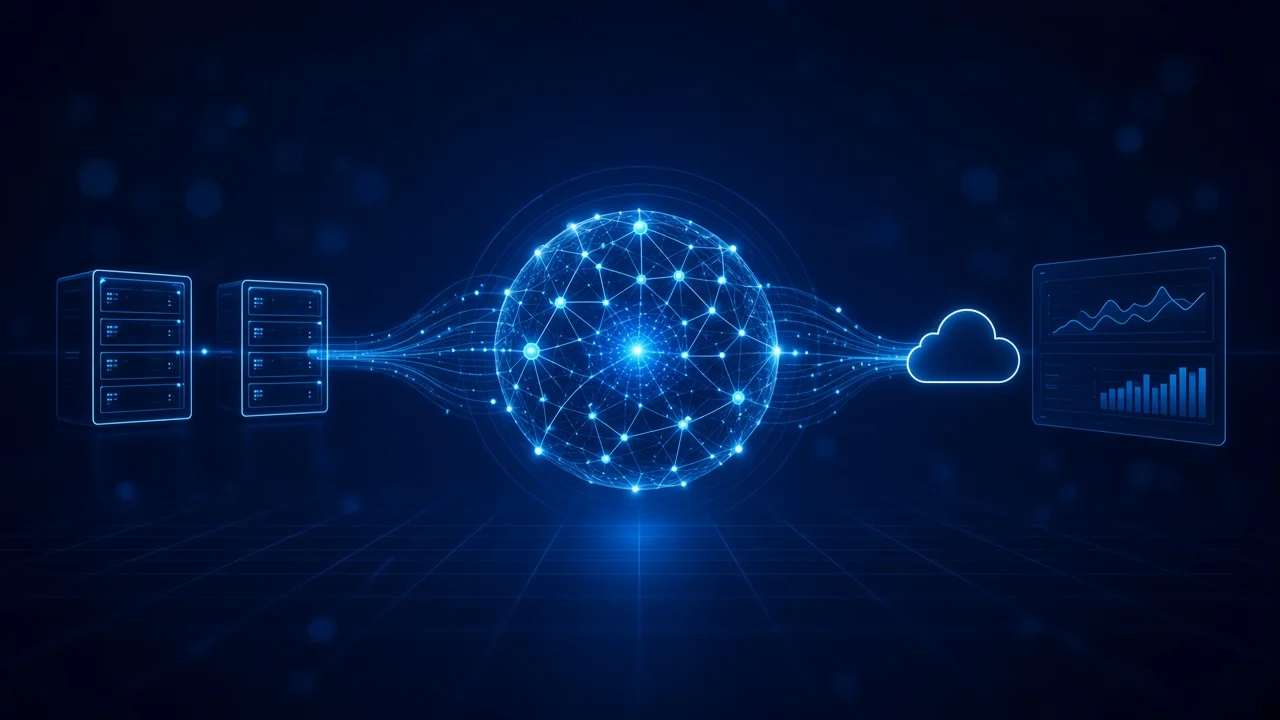
- Telemetry sources: applications, infrastructure, network, cloud, UC platforms and security tools.
- Data foundation: an OpenTelemetry-based pipeline that collects logs, metrics and traces in one consistent format, enriched with CMDB and topology data so the AI knows how services depend on each other.
- Correlation and machine learning: baselining, anomaly detection, event correlation and change correlation.
- AI agents: investigation and remediation agents that reach telemetry through governed interfaces. The Model Context Protocol (MCP) has become the standard way to do this. Datadog, for example, made its MCP Server generally available in March 2026, giving agents access to live observability data while respecting existing role-based access controls.
- Automation and ITSM: Ansible, Terraform and cloud APIs carry out actions, while ServiceNow or a similar platform tracks tickets, approvals and changes.
- Governance and guardrails: permissions, approval gates, audit logs and rollback span every layer.
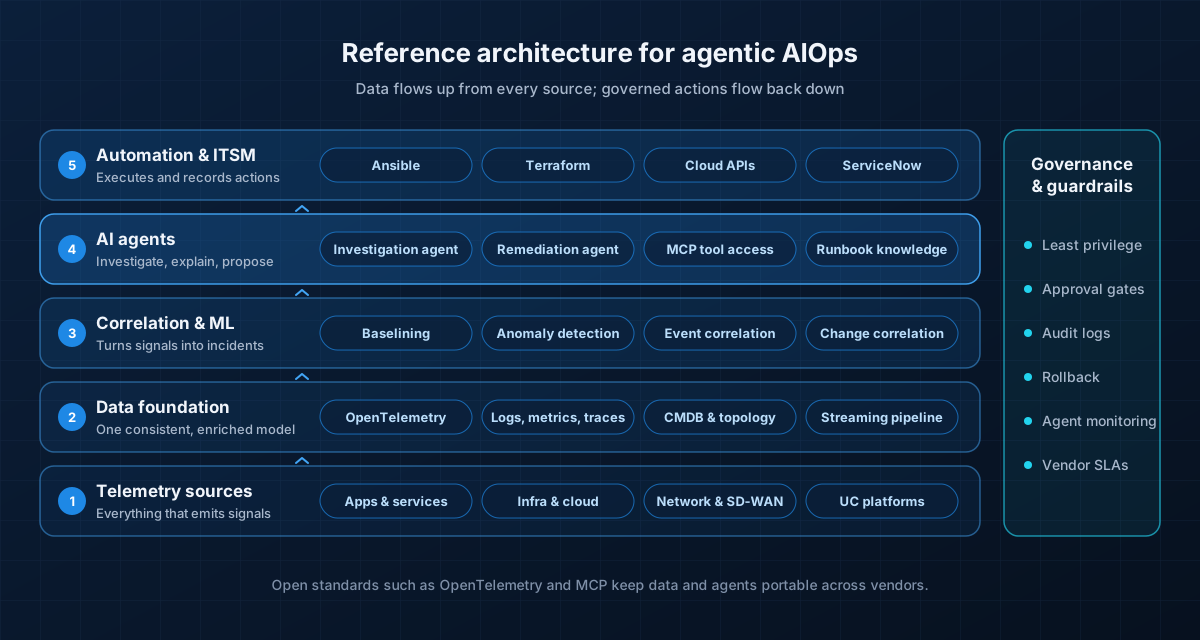 A reference architecture for agentic AIOps. Open standards such as OpenTelemetry and MCP keep the data and the agents portable across vendors.
Guardrails for Autonomous Operations
Trust is the main barrier to AIOps value, so build it deliberately.
- Define autonomy levels per use case:
- Level 0, observe: the agent watches and reports.
- Level 1, recommend: the agent proposes a diagnosis and fix; a person acts.
- Level 2, act with approval: the agent acts after a person approves.
- Level 3, act within bounds: the agent acts on its own within a tightly defined scope, such as restarting stateless services in non-production environments.
- Give agents least-privilege identities, just like human administrators, with separate credentials, scoped permissions and no shared admin accounts.
- Log every action with the reasoning, data used and outcome, so decisions can be audited and explained.
- Make every automated action reversible, and test rollbacks as part of the automation pipeline.
- Monitor the agents themselves. Trace their tool calls with OpenTelemetry, track error rates and cost, and alert on unusual behavior.
- Put performance commitments in vendor contracts. Gartner expects 50% of infrastructure and operations leaders to require AI agent performance SLAs in vendor contracts by 2028, up from less than 5% in 2025.
Measuring Success
Agree on a baseline before you start, then track:
- Mean time to detect (MTTD) and mean time to resolve (MTTR) for high-priority incidents.
- Alert-to-incident ratio: how many alerts it takes to produce one real incident.
- Percentage of incidents auto-resolved or resolved with an AI-proposed fix.
- Change failure rate and the number of incidents caused by changes.
- Toil hours spent on repetitive manual work.
- Agent accuracy: how often the agent's top root-cause hypothesis was correct.
- Observability cost: Elastic's research found that 71% of organizations regularly hit unexpected observability costs, so track spend alongside value.
Common Pitfalls
- Poor data quality. AI cannot correlate what it cannot see. Missing topology, inconsistent tags and siloed tools undermine everything else.
- Tool sprawl. Adding an AIOps layer on top of a dozen disconnected monitoring tools multiplies cost and confusion. Consolidate where you can.
- Too much autonomy too early. Letting agents act on production before they have earned trust is the quickest way to lose it.
- Ignoring the verification tax. Plan for a period of slower response while the team learns to work with agents.
- Not monitoring the agents. An unmonitored agent changing configurations is an incident waiting to happen.
- Skipping the people side. Roles shift from doing the work to supervising it. Invest in training, clear ownership and updated on-call processes.
A 90-Day AIOps Roadmap
Days 0 to 30: build the foundation
- Measure current MTTD, MTTR, alert volume and toil hours.
- Inventory monitoring tools and telemetry sources, and identify gaps.
- Standardize collection on OpenTelemetry for new services and enrich data with topology.
- Pick one or two noisy, well-understood services as the pilot scope.
Days 31 to 60: reduce noise and assist humans
- Turn on event correlation and anomaly detection for the pilot scope.
- Introduce an AI assistant for incident summaries and root cause suggestions, with humans making every decision.
- Start generating runbooks and postmortems with AI and review them carefully.
- Define autonomy levels, approval rules and audit logging.
Days 61 to 90: automate safely
- Automate two or three low-risk, reversible remediations with approval gates.
- Add monitoring for the agents themselves.
- Compare results with the baseline and share them with stakeholders.
- Plan the next wave of services and use cases based on what worked.
Conclusion
AIOps in 2026 is no longer about prettier dashboards. AI agents can now carry much of the investigative load that used to keep engineers up at night, and the leaders in Splunk's research are far more likely to see significant MTTR gains (63%) than everyone else (40%). The difference is not the model. It is clean data, open standards, careful guardrails and a team that knows how to supervise its new digital colleagues.
XeroStop helps enterprises design and run AI-driven operations across infrastructure, networks and unified communications. Explore our AI-powered UC monitoring and intelligent network automation solutions, or talk to our team about where AIOps can make the biggest difference for you.
Sources
- Gartner: Predicts 2026, AI Agents Will Transform IT Infrastructure and Operations
- Gartner: IT Infrastructure, Operations and Cloud Strategies Conference 2026 highlights
- Gartner: 2026 Strategic Roadmap for Agentic AI in Infrastructure and IT Operations
- Splunk: State of Observability 2026
- New Relic: 2026 Observability Forecast
- PagerDuty: 2026 State of AI-First Operations
- Riverbed: State of Autonomous IT Operations 2026
- IBM: ITOps hits a turning point with agentic AI
- NeuBird: 2026 State of Production Reliability and AI Adoption
- Elastic and Dimensional Research: Observability in 2026
- Datadog: MCP Server general availability (March 2026)
- CNCF: How Jaeger is evolving to trace AI agents with OpenTelemetry